
PART 2: Is it ARFID? Rethinking Eating Differences Through a Neurodiversity- Affirming Lens.

Updated: Sep 16
In Part 1, I explored why calling everything "picky eating" can lead us to miss what some children and families are actually experiencing. We looked at what ARFID is, how it shows up in real life, and why "wait and see" is rarely the neutral option it sounds like.
Since that post, a few questions have come up.
These are the three questions I want to explore here, and I'll close with how we can actually support children through it.

For those coming to this topic for the first time, a brief recap:
ARFID - avoidant/restrictive food intake disorder - is a feeding and eating disorder driven by sensory distress, fear of aversive effects such as choking or vomiting, or a genuinely low drive to eat. It's not about body image (although it can co-occur with other eating disorders, especially in the teen years). It can be diagnosed in children and adults at any stage of life. It often overlaps with neurodivergence, and can look very different from one person to the next. It can be diagnosed in children and adults at any stage of life.
Certain groups also carry a notably elevated risk: EDFA reports that trans and gender diverse people are 85 times more likely to experience ARFID.
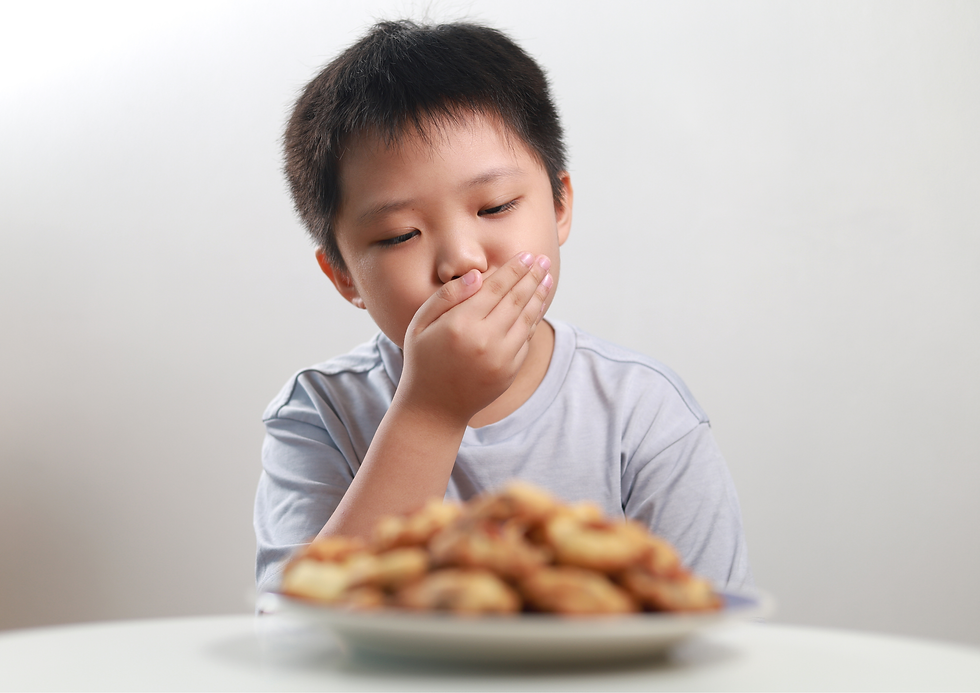
My child is growing well. Can it still be ARFID?
Yes.
To be diagnosed with ARFID, the restriction needs to result in at least one of the following:
significant nutritional deficiency, or dependence on oral nutritional supplements or enteral (tube) feeding
marked interference with psychosocial functioning
low weight or faltering growth
Weight loss or growth faltering is therefore one possible outcome for ARFID, not a requirement.
In this work, we see many children, teens, and adults with ARFID track steadily along their growth curves, maintain their weight, or have larger bodies. This is often true for children who can meet their calorie requirements because their safe food(s) are energy-dense (meaning high in calories).
In addition, growth charts can mislead us. A child might appear to be growing "fine" on a population growth curve, but if you factor in their genetic potential (like mid-parental height estimate), or their growth history over time, the picture changes. Some children deviate from their own or expected growth curve without ever dropping below a threshold that would raise a flag. As a result, they may be height- or weight-suppressed.
Of course, weight and growth are part of the diagnostic picture, and a clinician should assess a child's growth carefully across the lifespan as part of any thorough assessment and intervention plan. But in day-to-day clinical practice, weight change is often not the most obvious sign, and it's not the most reliable one either.
There is also a growing clinical consensus in the field of eating disorders, for example, as reflected in 2026 NHS guidance for recognising eating disorders in children, which moves away from BMI thresholds. Weight is a poor proxy for malnutrition and medical risk.
In eating disorder care, it is well established that children and young people can be severely nutrient-deficient and medically at risk without having lost any weight at all, and in some cases even while actively gaining weight.
When weight appears "fine", families are frequently reassured that there's nothing to worry about. Meanwhile, eating may be increasingly stressful, limited to a shrinking list of safe foods, causing significant nutritional deficiency and reduced quality of life, or causing significant psychosocial stress.
This is one of the many reasons I practise through a weight-neutral lens. Weight is only one data point, and on its own, it tells us very little about a child's health or their relationship with food. Denying a child support or healthcare based on their size is weight discrimination, and in eating disorder care, it can cause serious harm.
Disordered eating doesn't always look like weight loss, and nutritional risk and malnutrition
aren't always visible from the outside.

Is my child's eating a difference, a difficulty, or a disorder?
This is an important question, and one that cannot be collapsed into a simple yes-or-no.
Not all "picky eating" is fine, typical, or something kids just grow out of. And not all eating that looks "different" from the outside is a problem.
Many neurodivergent children prefer routine, predictability, and familiar sensory experiences when it comes to food. Eating the same meals for days, using the same plate, or preferring to eat alone can be forms of regulation and safety rather than pathology.
I, along with many of my like-minded colleagues in the field, find it helpful to think about selective eating across a spectrum with three main categories.
Eating differences are feeding and eating behaviours related to neurotype or sensory preferences. They may not fit a neurotypical idea of "normal" or "typical", but they don't cause distress to the child or result in nutritional deficits. In everyday life, this might look like a child who:
Prefers to eat with their hands* rather than cutlery
Wants to explore food through touch or smell before eating
Requires movement during meals - standing, pacing, bouncing
Uses eating as a form of stimming
Prefers to eat alone rather than in social settings
Relies on familiar, predictable foods to feel safe enough to eat
Needs external cues to remember to eat (as opposed to relying solely on hunger cues)
Prefers to eat while wearing headphones or watching a screen
Through a neurotypical lens, these behaviours are often labelled as "bad manners" or "problems to fix". For many children and adults, they are adaptive strategies for a neurodivergent nervous system - ways of regulating, reducing sensory load, and accessing food.
Side note: It took me a while to be okay with putting differences on this spectrum. I don't see them as problems to fix — but then I realised they can create vulnerability if they're not accommodated. Including them isn't about pathologising; it's about offering support and advocacy early, so that a difference stays a difference. These behaviours call for accommodation, not elimination.
Eating difficulties sit in the middle. These are also feeding and eating behaviours related to neurotype or sensory preferences, but they result in difficulties for the child. For example, in their mental health (such as stress or anxiety) or their physical health (such as low iron, constipation or poor growth).
In practice, this might look like a child who cannot eat when she is around other people, and because the school doesn't allow for accommodations around mealtimes, she goes without food for most of the school day. This negatively affects her nervous system, energy levels, mood, and ability to concentrate and causes her gastrointestinal symptoms to worsen.
Disordered eating or an eating disorder involves feeding and eating behaviours that are not in line with the child's true preferences, and that cause consistent mental and/or physical health difficulties over time. This is where ARFID becomes most relevant. A child who wants to eat something, but simply cannot.

For clinicians, this asks us to pause and check: are we responding to difference, or to genuine risk and distress?
A question I often return to in my own practice is: if the right accommodations were in place, could this child meet their nutritional needs? And perhaps more importantly: Whose goals are we actually working toward, the parents' or the individual's?
This is incredibly nuanced and complex, especially with children. A parent's goals and a child's goals aren't always the same, and whose goals we centre matters. At the same time, we, as caregivers and health professionals, carry real responsibility for a child's current and long-term well-being. Holding both of those at once is the hard, important part.
It's also a reminder that navigating this well rarely falls to one person. An interdisciplinary approach, where different perspectives are brought together thoughtfully, tends to serve children best. And within that, creating genuine space for the child's own voice is essential.

Will my child's eating ever change?
The honest answer is: it depends.
That's not a cop-out. ARFID is still significantly under-researched, and under the umbrella of a single diagnosis sits an enormous range of presentations. If you've met one person with ARFID, you've met one person.
So I'm wary of anyone who promises a definite answer — and it's why I really don't like seeing practitioners and influencers selling "reverse" picky eating courses to vulnerable families. When someone guarantees an outcome for a condition this varied and this under-researched, that should be a red flag.
But here's what we do know: change is possible. And even where it's slow or uncertain, we can always reduce harm and support anyone who's suffering.
Someone may have underlying medical factors that have never been identified. A gut condition that makes eating genuinely uncomfortable or painful, or a chronic medical condition, for example, Hypermobile Ehlers-Danlos (hEDS), that affects appetite. When those are finally recognised and managed, eating can start to shift.
For others, eating difficulties emerged after a frightening or traumatic experience. When the nervous system has had the chance to heal, through therapy, time, or the right support, eating often follows.
I've heard from many adults with eating difficulties that things shifted meaningfully when they learned more about their nervous system and what they needed, and gained autonomy over their eating environment and food. When they could access the sensory accommodations they needed, cook the food themselves or simply stop being pressured, something shifted.
Many children and adults expand their eating over time. For others, expansion isn't the goal; they learn to live well alongside the condition and build lives that are successful, full, and content.

So how do we support children and young people with ARFID?
Without guidance, families are often left guessing. Mealtimes can become tense. Parents feel obligated to use shame, guilt, bribery and punishment to "get their child to eat". It doesn't feel good, but at least it feels like they're doing something. And over time, what might have begun as a difference can become more entrenched.
On the other hand, many parents simply "give up". They make peace with their child's eating and try to be supportive by offering any and all accommodations. While that may cause far less harm than the first scenario, it can also mean a child goes unsupported, still really struggling, and potentially missing important nutrients. Parents are often exhausted too, and some even develop a deep resentment.
Early support isn't about waiting it out or forcing change. It's about reducing stress, maintaining nutrition, and preserving both a child's relationship with food and the parent child relationship.

Neuro-affirming, responsive feeding care isn't passive, and it isn't the easy route.
Creating safety, adjusting mealtime environments, supporting the nervous system, and working with what a child currently accepts to meet their nutritional requirements are active, intentional interventions. They require a great deal of skill, consistency, and attunement.
My focus is always on meeting a child's nutritional needs safely — and safety is what makes that possible. That means reducing fear and nervous system activation rather than pushing through it, and building predictability and trust. I work with what is already accepted, moving gradually and only when a child feels safe enough to do so.
For some children, that also includes oral nutritional supplements. This is not something to be embarrassed about; it's simply one more way to make sure a child's body has what it needs while everything else is being worked on.
Progress is often slow and non-linear. It might look like eating a safe food more regularly during the day. Or being okay with a different brand of potato crisps. Being able to sit near a food without distress. Smelling something without gagging.
These are real steps, even when they don't look dramatic from the outside.
For clinicians, supporting a child or teenager with ARFID also means being willing to look beyond the presenting behaviour, to explore underlying medical factors with openness and curiosity, to keep reading and learning, and to examine the ways our own assumptions about bodies, health, and "normal" eating can get in the way of seeing a child clearly.
In the end, our children deserve care that meets them where they are.
Whatever their eating looks like.
*Eating with utensils is a cultural norm rather than a marker of skill. In many parts of the world, eating with hands is the norm.


Comments